Home Cooking Journal
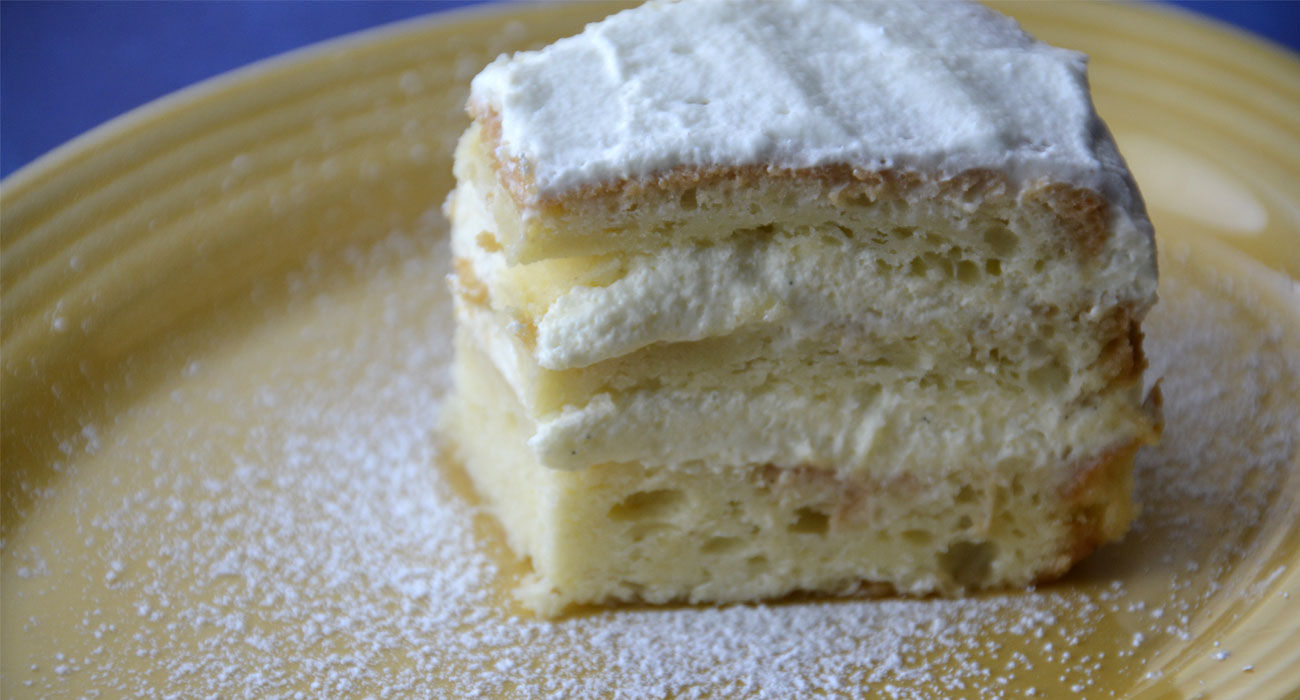
COCONUT CAKE BY SAVEUR MAGAZINE
INGREDIENTS Serves 10-12
16 tbsp. unsalted butter, softened, plus more for pans
2 1/2 cups cake flours, plus more for pans
1 tsp. baking soda
1 tsp. kosher salt
1 cup buttermilk
1 tbsp. vanilla extract
2 cups sugar
5 eggs
FOR THE FROSTING
4 egg whites
1/2 tsp. cream tartar
2 1/4 cups sugar
1/4 cup light corn syrup
1 tsp. kosher salt
2 tsp. vanilla extract
3/4 cup fresh coconut water
3 cups freshly grated coconut
RECIPE TWISTS
We used coconut cream instead of coconut water, and the freshly grated coconut was replaced with regular sweetened grated coconut. In addition we added pineapple small cubes within the cakes layers.
HOW TO DO IT
1. Make the cake: Heat the oven to 350°F. Butter and flour two 9″ cake pans and set aside. Whisk together flour, baking soda, and salt in a bowl; set aside. Whisk together buttermilk and vanilla in a bowl; set aside. In the bowl of a stand mixer fitted with a paddle, cream butter and sugar on medium-high speed until pale and fluffy, about 3 minutes. Add eggs one at a time, beating well after each addition. On low speed, alternately add dry ingredients in 2 batches. Increase speed to high, and beat until batter between prepared pans, and smooth top with a rubber spatula; drop pans lightly on a counter to expel large air bubbles. Bake cakes until a toothpick inserted in middle comes out clean, about 35 minutes. Let cakes cool for 20 minutes in pans; invert onto wire racks, and let cool. Using a serrated knife, halve each horizontally, producing four layers; set aside.
2. Make the frosting: Place eggs whites and cream of tartar in the bowl of a stand mixer fitted with a whisk, and beat on medium-high speed until soft peaks from; turn mixer off. Bring sugar, syrup, salt, and 1/2 cup tap water to a boil in a 2-qt. saucepan over high heat, stirring to dissolve sugar; attach a candy thermometer to side of pan, and cook, without stirring, until thermometer reads 250°F, 4-5 minutes to medium speed, and very slowly drizzle hot syrup into beating eggs whites. Add vanilla, and increase speed to high; beat until meringue forms stiff peaks and is sightly warm to the touch, about 3 minutes.
3. To assemble, place one layer on a cake stand, drizzle with 3 tbsp. coconut water, spread with 1 1/2 cups of frosting, and sprinkle with 1/2 cup grated coconut; top with another cake, drizzle with 3 tbsp. coconut water, spread with 1 1/2 cups frosting, and sprinkle with 1/2 cup coconut. Place another cake over frosting, drizzle with 3 tbsp. coconut water, spread with 1 1/2 cups frosting, and sprinkle with 1/2 cup coconut; top with remaining cake and drizzle with remaining coconut water. Cover top and sides with remaining frosting, and cover outside of cake with remaining coconut, pressing it lightly to adhere; chill cake to firm frosting. Serve chilled or at room temperature.
By mondo
Published: March 4, 2012
2 Comments
POTATO PAVE | A RECIPE BY THOMAS KELLER
INGREDIENTS (Serves 6)
1 cup heavy cream
Kosher salt and freshly ground black pepper
3 pounds russet potatoes (three 1-pound potatoes if possible)
5 tablespoons (2 1/2 ounces) unsalted butter, 1 tablespoon softened and 4 tablespoons (2 ounces) cut into 1/2-inch cubes
Canola oil
2 thyme springs
2 garlic cloves, lighted crushed, skin left on
Minced chives
PREPARATION
1. Preheat the oven to 350°F
2. Pour the cream into a large bowl and season with 1 teaspoon salt and 1/2 teaspoon pepper. Peel the potatoes. Cut a thin lengthwise slice off one side of a potato so it will rest flat on the mandoline. Lay a Japanese mandoline or other vegetable slicer over the bowl of cream and slice the potato lengthwise into very thin (about 1/16 in) slices, letting them drop into the cream. (If you can’t lay your mandoline across the bowl, slice the potatoes, adding the slices to the cream as you go.) Stop from time to time to toss the slices in the cream to keep them coated and prevent them from oxidizing. Repeat with the remaining potatoes.
3. Brush a 10-by 6 1/2 by 3 inch-high pan with half the softened butter. (Don’t use a shallower pan–you need the depth this size pan gives the pavé.) Line with parchment paper, leaving a 5-inch overhang on the two long sides. These extensions will be used to cover the potatoes as they cook and later serve as handles when unmolding. Brush the parchment with the remaining softened butter and sprinkle with salt and pepper.
4. Trim the potato slices to form a solid even layer in the bottom of the pan and lay them in the direction that works best to fill the pan. Repeat to form a second layer. Dot with a few cubes of butter and sprinkle lightly with salt and pepper. Continue layering the potatoes, adding butter and seasonings after each two layers. Fold over the sides of the parchment paper to cover the potatoes. Cover tightly with a piece of aluminum foil (to allow the potatoes to steam as they bake).
5. Bake the potatoes for 1 hour and 50 minutes, or until completely tender when pierced with the tip of a knife.
6. Remove from the oven and let them cool for 15 minutes. Put a weight on top of the potatoes (see Note), cool to room temperature, wrap well, and refrigerate for at least 6 hours, or up to 2 days.
7. To serve, run a palette knife around the two longer sides of the pavé to release it from the pan, or invert onto a cutting surface. Trim all sides of the pavé. Cut the pavé into 12 equal pieces and let sit at room temperature for 30 minutes.
8. Heat some canola oil in a large frying pan over medium-high heat. Add the potatoes cut-side-down, add the thyme and the garlic, and cook, basting with the liquid in the pan, until browned on the first side, then turn carefully and brown the opposite side.
9. Arrange the potatoes on a serving platter, browned side up. Put a small piece of butter on each piece to melt, and sprinkle with chives.
Note: The easiest way to weight the pavé is to cut a piece of cardboard just smaller than the top of the pan, so that it will cover the top of the pavé without resting on the sides of the pan. Wrap a cardboard in aluminum foil, set it on top of the pavé, and place a few cans or other weights on the cardboard for a even weight distribution.
By mondo
Published: December 30, 2011
One Comment
BEEF EMPANADAS
FILLING INGREDIENTS ( “PINO”) – for 16 large empanadas
Pino is a seasoned mixture of ground beef, onions, raisins, black olives, and hard boiled eggs. The “pino” tastes best if made the day before and allowed to rest overnight before filling the empanadas.
2 lb of london broil
4 large Spanish onions, chopped
8 cups of beef broth
2 teaspoons cumin
1 teaspoons chile powder
1 tablespoon smoked paprika
2 tablespoons flour
1/2 cup raisins
16 Alfonso Olives
2 hard boiled eggs, sliced
PREPARATION
1. Saute the onions and garlic in the vegetable oil and butter until softened. Add the cumin, chile powder, smoked paprika and salt and pepper to taste.
2. Season the meat and sear it on a saute pan.
3. Simmer the beef on the beef broth and a quarter onion for 30 minutes. Remove the meat from the broth, let it cool and chop it. Mix it with the sautéd onions to create a wonderful pino.
4. Fill the empanadas with the pino, olives, raisin and boiled egg.
5. Before baking the empanadas, brush them with a mix of 1 egg white and 2 spoons or water to get a nice shine.
6. Preheat the oven at 400°F
7. Bake them for 35 minutes or until golden brown.
8. Let them cool for 1 hr before serving.
DOUGH INGREDIENTS – for 16 large empanadas
8 cups all purpose flour
4 teaspoons salt
4 teaspoons sugar
4 tablespoons butter, melted
24 tablespoons lard or vegetable shortening, at room temperature
1 cup plus 1 tablespoon cup water
PREPARATION
1. Sift the flour into a bowl. Stir in the slat and the sugar.
2. Melt the butter with the lard or shortening, and stir into the flour with a fork.
3. Add the vegetable shortening or lard, and knead until it fairly well blended with the flour.
4. Stir in the 1 cup of water, a little at a time until the dough comes together smoothly. Keep kneading the dough, adding water if necessary, until the dough is very smooth, about 5-10 minutes. You can knead the dough with a standing mixer and a dough hook attachment.
5. Cover the dough with plastic wrap and let rest on the counter for about a half hour. (Dough can also be kept overnight in the refrigerator, then brought to room temperature before using.) Dough should be soft and smooth, and not elastic – if you poke a hole in it with your finger, the indentation should remain.
6. Turn dough out a floured surface, and roll into desired thickness making 8 in circles.
By mondo
Published: November 19, 2011
One Comment
VIETNAMESE PHO
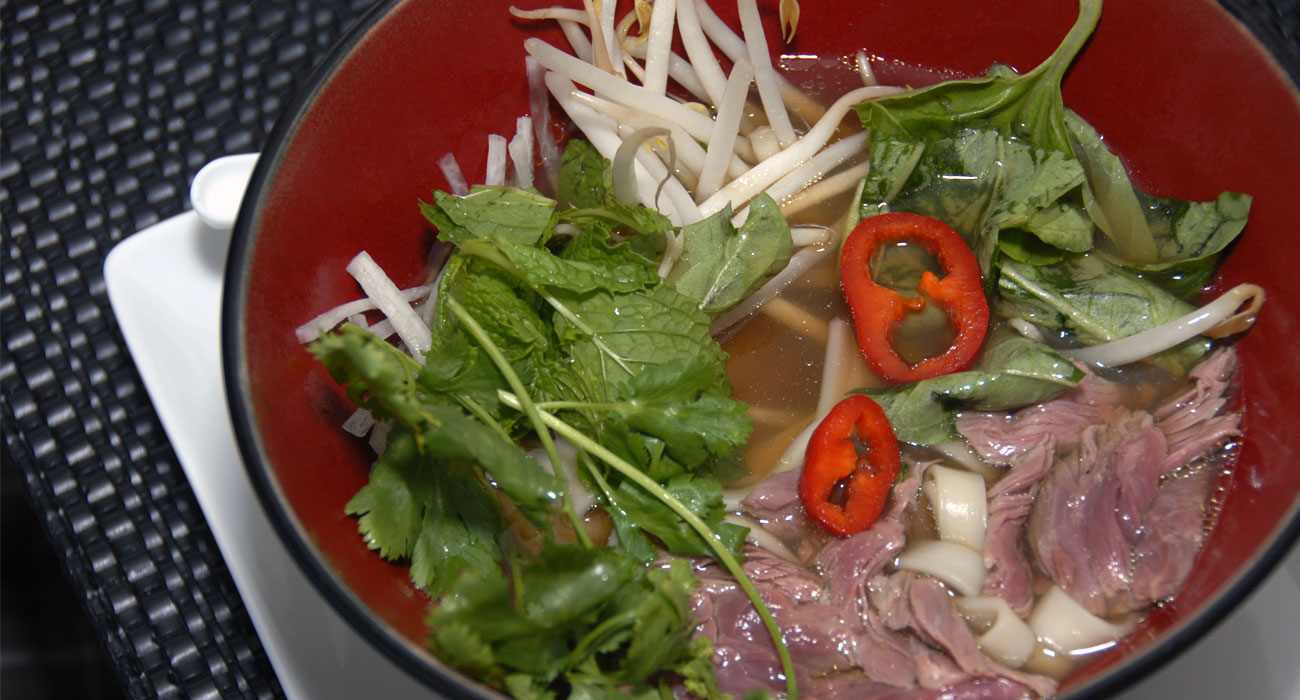
After reading several recipes, we decided to make Pho at home. Essentially the broth is the soul and body of the dish. Apparently, street vendors in Hanoi spend hours preparing their broth to sell in their street carts the next day.
In my version, I start by blanching a whole lot of bones with marrow and cartilage like shanks, ribs and knuckles, in cold water, bringing up to a simmer for 45 minutes, then strain and discard blanching water. I roasted the bones on a baking sheet lined with aluminum foil, at 400°F for one hour. About 30 minutes into this roasting, I added to the baking sheet some aromatic spices , like ginger, garlic, cloves, cardamom, star anise, cumin seeds, coriander seeds, onion wedges and pepper corns.
Then a made a “tea” with the roasted bones and spices, by steeping them in one gallon of simmering salted water for about 3 hours. Then I strained and separated the fat (to do this you can let it cool down -a lot- then just remove the floating layer of hardened fat leaving all the good flavors in the broth.
To serve, heat the broth and in a separate pot boil salted water and cook wide fresh rice noodles. Scoop some cooked noodles into a bowl and drop some thinly cut slices of beef. Then ladle some very hot broth over the noodles, to cover them and serve, along with veggie garnishes like cilantro, soy bean sprouts, mint leaves, shredded Daikon, sliced hot peppers and lime wedges.
By mondo
Published: November 4, 2011
No Comments
MONDO DINNER GUEST COOK: RODRIGO PALACIOS AND HIS CAUSA
Causa, sometimes called Causa Limeña or Causa Peruana is a popular Peruvian dish. It’s basically a cold potato salad that can be presented in many different ways, like molded individually in ring molds or pressed into a terrine in loafs pans lined with plastic wrap and filled with almost anything that can be served cold. The most common fillings are seafood like shrimp or tuna salad or cold chicken salad, with mayonnaise as binder. After molded is usually plated over a bed of lettuce and decorated with mayonnaise, boiled eggs, avocado and black olives. While visiting us, our good friend Rodrigo Palacios, AKA Palace prepared a delicious Causa for us one night. This is his version of the recipe.
INGREDIENTS
2 lbs of yellow potatoes, peeled and diced
3/4 cup of Aji Amarillo in paste*
1/4 cup of lime juice
1/3 cup of vegetable oil
Salt
FILLING AND DECORATION
1 lb large cocked and peeled shrimp
3/4 cup of mayonnaise, preferably home made
1 large avocado
2 hard boiled eggs
1/ cup of pitted black olives
Lettuce leaves
1. Starting with cold water, boil potatoes until soft. While still hot, drain, place in large bowl and mash. add all of the Aji amarillo paste, the lime juice, a t.sp. of salt and the oil and mix until is a uniform yellow mash.
2. In a loaf mold lined with plastic wrap in a big enough piece that you still have plastic hanging out that can be used to cover the mold when done. For the bottom layer use half of the cooled potato mix and press down with fork or hands to make it even flat. Now for the filling, place over the potatoes a layer of the cocked shrimp, using most of them (about 3/4 lb and reserve remaining for decoration). Use 3/4 of the avocado, sliced on this layer. Reserve the rest for decoration.
3. Now top this with the remaining potato mix. Lightly press down again.
4. Cover with the hanging plastic and refrigerate at least one hour. It can be made several hours in advance.
5. When ready to serve, place some lettuce leaves, whole or chopped over a platter and unmold the loaf removing plastic wrap.
6. To decorate: On top, place alternated slices of hard boiled egg, shrimp, avocado and mayonnaise rosettes (using a decorating pipe) with a olive on top of each mayonnaise mound.
*Aji amarillo, is very common ingredient in South America, but very hard to find here in NY. Its a mild to hot yellow pepper that is used fresh, steeped in boiling water and pureed in a blender wit a little oil and salt. To substitute this, Palace used a yellow bell pepper and one whole habanero pepper, chopped roughly and steeped in a cup of boiling water for 5 minutes, then pureed in the blender for a minute.
By mondo
Published: August 28, 2011
2 Comments
LABELING BEER BATCH N15 | CHAGALANTE 02: SMOKED PALE ALE
Chagalante 02
Smoked Pale Ale
Bottled in Brooklyn on 8.20.2011
45 bottles, 12 oz.
35 IBU
W. yeast 1056 American Ale
6.2% ABV
By mondo
Published: August 28, 2011
No Comments
LABELING BEER BATCH N14 | CHAGALANTE 01: SMOKED PALE ALE
Chagalante 01
Smoked Pale Ale
Bottled in Brooklyn on 7.2.2011
45 bottles, 12 oz.
34.8 IBU
W. yeast 1056 American Ale
6.3% ABV
Label design inspired by Ed Emshwiller’s illustration “Have space-suit, will travel”
By mondo
Published: August 28, 2011
No Comments
BRAISED BEEF SHORT RIBS | RECIPE BY THOMAS KELLER
You can find this recipe and other wonderful ones on Thomas Keller book Ad Hoc at Home
RED WINE REDUCTION
1 (750-ml) bottle dry red wine, such as Cabernet Sauvignon
1 cup diced (1/2-inch) yellow onion
1 cup 1/2-inch-thick slices peeled carrots
1 cup 1/2-inch-thick slices leeks (white and light green parts only)
1 cup thinly sliced shallots
1 cup thinly sliced button mushrooms and/or mushrooms stems
3 thyme sprigs
6-flat-leaf parsley sprigs
2 bay leaves
1/2 teaspoon black peppercorns
3 large garlic cloves, smashed, skin left on
BRAISE
1 piece (about 2 1/2 pounds) boneless chuck short rib
Kosher salt and fresh ground black pepper
All-purpose flour
Canola oil
1 cup diced (1/2 inch) yellow onion
2/3 cup 1/2-inch thick slices peeled carrot
1 1/2 cup 1/2 inch thick slices leeks ( white and light green parts only)
2 garlic cloves, smashed, skin left on
3 thyme sprigs
2 bay leaves
About 5 cups beef stock
Braising is such a satisfying process for the cook. First, you brown the ribs in fat, then cook them in a rich braising liquid–until they’re tender but still have some body to them, not until they’re falling apart–then cool them in the braising liquid. The flavor improves with time, so these are actually best cooked at least a day before you plan to serve them.
Ask your butcher for a cut called “boneless chuck short rib.” Cooking it whole off the bone allows you to cut portions as you wish after it has cooked. Serve this with a rich, creamy side dish, such as Polenta, puree of garlic potatoes or celery root with melted onions.
HOW TO DO IT
1. Combine all the ingredient for the red wine reduction in a large Dutch oven or other heavy oveproof pot that will hold the meat comfortably.
2. Bring to a simmer over high heat and reduce the heat to maintain the simmer for 45 to 50 minutes, until the the wine has reduced to a glaze.
3.Meanwhile, trim any pieces of sinew from the top of the short ribs; leave the layer of fat and silverskin. Remove any remaining connecting tissue from where the bones were removed. Season all sides generously with salt and pepper and coat in flour, patting off any excess.
4. Heat some canola oil in a large sauté pan over high heat until it shimmers. Add the meat fat-side-down, reduce the heat, and brown the meat for 3 minutes. Turn the meat and brown the other side.
5. Preheat the oven to 350°F.
6. Add the onion, carrots, leeks, garlic, thyme and bay leaves to the wine reduction and toss together. Cut a piece of cheesecloth about 4 inches larger than the diameter of the pot. Moisten the cheesecloth and wring dry, place over the vegetables, and fold over the edges to form a “nest” for the meat. (The cheesecloth will allow the liquid to flavor and cook the meat but prevent bits of vegetables and herbs from clinging to it). Put the meat on the cheesecloth and add the stock; it should come just to the top of the meat. Cut a parchment lid and place it over the meat.
7. Transfer the pot to the oven, reduce the heat to 325°F, and braise the beef for 1 1/2 to 2 hours, until very tender. To check, uncover the meat and press on it: the fibers should separate as you press down, but the meat shouldn’t be falling apart.
8. Transfer the meat to a heatproof container. Strain the braising liquid twice through a fine-mesh conical strainer into a bowl, then strain into a fat separator or deep bowl and allow the fat to rise to the top.
9. Skim off the fat and strain the liquid over the meat. (The meat can be refrigerated in the liquid for up to 3 days, the finished as follows. Or it can be used to make beef Stroganoff or Catalan beef stew.)
10. To get ready to serve, preheat the oven to 400°F.
11. Remove any solidified fat from the surface of the liquid. (If the liquid has gelled, place the container in the oven or microwave and heat until the liquid melts and you can remove the meat without breaking it.)
12. Put the fat-side-down in a ovenproof sauté pan and pour about 1/4 inch of the braising liquid. Pour the remaining liquid into a saucepan, bring to simmer, and simmer until reduced to a sauce consistency. Remove the sauce from the heat.
13. Meanwhile, put the pan of short ribs over medium heat and bring to a simmer, spooning the juices over the meat. Transfer the uncover pan to the oven to heat through, about 15 minutes, basting with the juices once or twice. Turn the meat over and baste generously with the juices. Return to the oven for another 5 minutes or so, basting two more times, until the meat is hot and richly browned with the sauce.
14. Arrange the meat on a platter and spoon the sauce over it.
By mondo
Published: August 28, 2011
No Comments
Page 1 / 66